
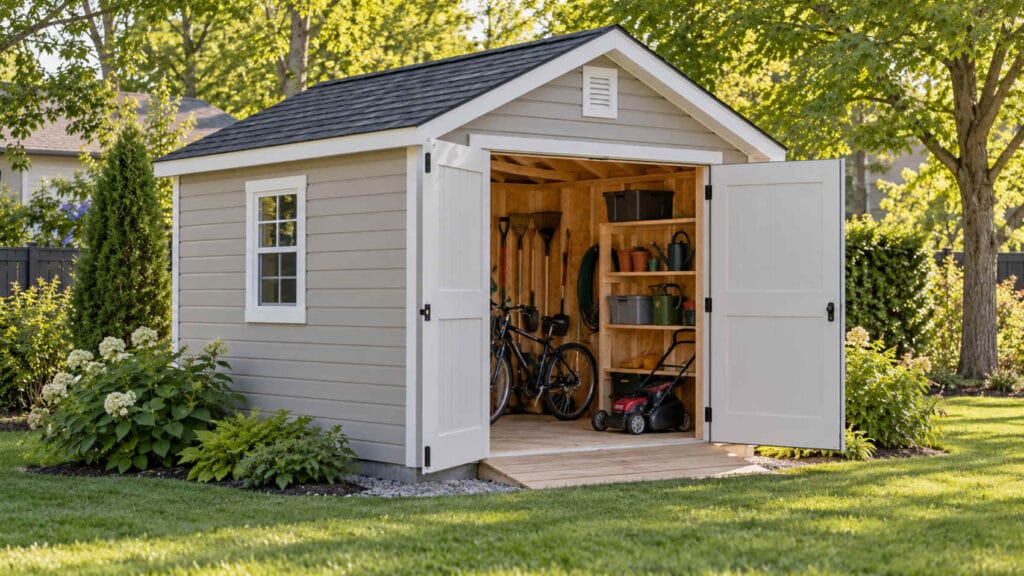
Is your garage overflowing, are bikes taking up all the room, and are gardening tools scattered everywhere? A shed can help you get your backyard organized. The key is choosing a size that suits what you need to store.
Too small, and it quickly becomes cluttered. Too large, and it takes up more yard space than necessary. The right shed size depends on your equipment, the space available, and how you use your storage day to day.
Before choosing your model from Cabanons Boyer, take the time to assess your needs. Here are the main factors to consider when selecting a practical, well-proportioned shed that suits your property.
What shed size do you need for storage?
Your first instinct may be to look at the available space in your yard. However, a better starting point is to list the items you want to store. You can then compare your storage needs with the space available on your property.
Think about gardening tools, your lawn mower, bicycles, seasonal tires, pool accessories, and outdoor furniture. Remember the items you only use a few times a year, such as decorations or patio cushions.
Measure your largest pieces of equipment. A lawn mower, snow blower, and large patio table can take up much more space than expected when stored together.
Also separate frequently used items from those that will remain in storage for several months. This will help you plan a layout that keeps everyday items within easy reach.
Planning your shed size for the years ahead
Your situation may change. New bicycles, a pool, or additional yard maintenance equipment could increase your storage needs.
You do not necessarily need the largest model, but it is wise to leave some room to grow. A shed that is full as soon as it is installed leaves little space for future purchases and becomes harder to organize.
Which shed size suits your intended use?
Dimensions provide an initial idea of storage capacity. However, two sheds with the same floor area can function very differently depending on the placement of doors, shelving, and equipment.
The following sizes offer useful starting points for planning your project. Their suitability will always depend on the actual dimensions of your belongings and your planned interior layout.
A small shed for tools and accessories
A compact shed may be suitable if you mainly want to store hand tools, pots, gardening supplies, and a few small pieces of equipment.
For example, a 4 × 6-foot footprint represents 24 square feet. This is an option to consider when your storage needs are limited and every part of your yard counts.
In a small space, wall storage is especially useful. Hooks can hold shovels and rakes, while shelves provide room for accessories. Still, check the remaining floor space before planning to add a lawn mower or bicycle.
A medium-sized shed for several types of equipment
An 8 × 10-foot shed has a footprint of 80 square feet. It can be a useful starting point when planning storage for several categories of items.
You could plan one area for tools, another for wheeled equipment, and shelving for seasonal accessories. Actual capacity will depend on how much space each item takes up.
To determine whether this shed size works for you, draw a simple floor plan. Place your items to scale and include enough room to move around. You will quickly see whether your proposed layout is realistic.
A large shed for greater storage needs
If you want to store several bicycles, yard maintenance equipment, and patio furniture together, a more spacious shed is worth considering.
A 12 × 16-foot footprint represents 192 square feet. This gives you more layout options, although it does not guarantee that all your equipment will fit comfortably.
The height of your items, door width, and shelf depth still matter. Explore Cabanons Boyer’s storage shed and garden shed models to compare your options and confirm the available sizes.
Choosing a shed size that fits your property
Once you have identified your needs, assess the proposed location. Your shed should fit into your yard while leaving enough room for other activities.
Consider your patio, garden, pool, and the pathways you regularly use. A practical shed should not make these areas harder to access.
To get a better sense of its size, mark the shed’s footprint with string or stakes. Walk around the area and imagine opening the doors. This simple check will help you understand how the shed will affect your yard’s layout.
Also consider the route between the shed and the areas where you use your equipment. If you have to navigate several obstacles to get your lawn mower out, you may want to reconsider the location.
Finally, ask your municipality to confirm the requirements that apply to your project before making your final choice. Have the proposed dimensions, location, and necessary approval process checked.
Accounting for usable interior space
Multiplying width by depth gives you a reference area. However, this does not necessarily represent all the space available for your belongings.
Ask whether the advertised dimensions are exterior or interior measurements. Wall thickness and the building’s configuration affect the usable space.
Next, account for any shelving, cabinets, or workbench you want to install. Deep shelving reduces the width of your walkway, even when it improves storage capacity.
Leave an aisle to reach items at the back. You should be able to take out a bicycle or grab a tool without having to move several other things every time.
The best size is therefore more than one that simply holds your equipment. It should let you access your belongings easily, put them away, and keep the interior organized.
Choosing doors that suit your stored items
The right shed size is not enough if the doorway is too narrow for your equipment. Check the clear opening width and height, especially for a snow blower, lawn mower, or furniture.
Double doors can make moving certain items easier. Their location also matters. A well-positioned doorway leaves wall space available for shelving and provides more direct access to bulky equipment.
Explore the shed door options to consider which configuration would work best for your needs.
Also think about the outdoor space in front of the entrance. You will need enough room to open the doors and manoeuvre your equipment comfortably.
Finding the right shed size with Cabanons Boyer
Before making your choice, gather a list of your equipment, its measurements, and a few photos of the proposed location. This information will make it easier to discuss sizes and layouts.
Cabanons Boyer offers storage sheds and garden sheds in several sizes. The goal is to choose a model that meets your storage needs while fitting the space available in your yard.
Trying to decide between two sizes? Contact the Cabanons Boyer team to discuss your project and confirm your options. A carefully considered choice will give you accessible, practical storage, season after season.